

EURA 2027 – Save the date
24/09/2026
Conversation #86
Reading the city from behind:
the spatial alchemy of Belfast’ back alleys
by Cristian Silva
Queen's University Belfast, Northern Ireland
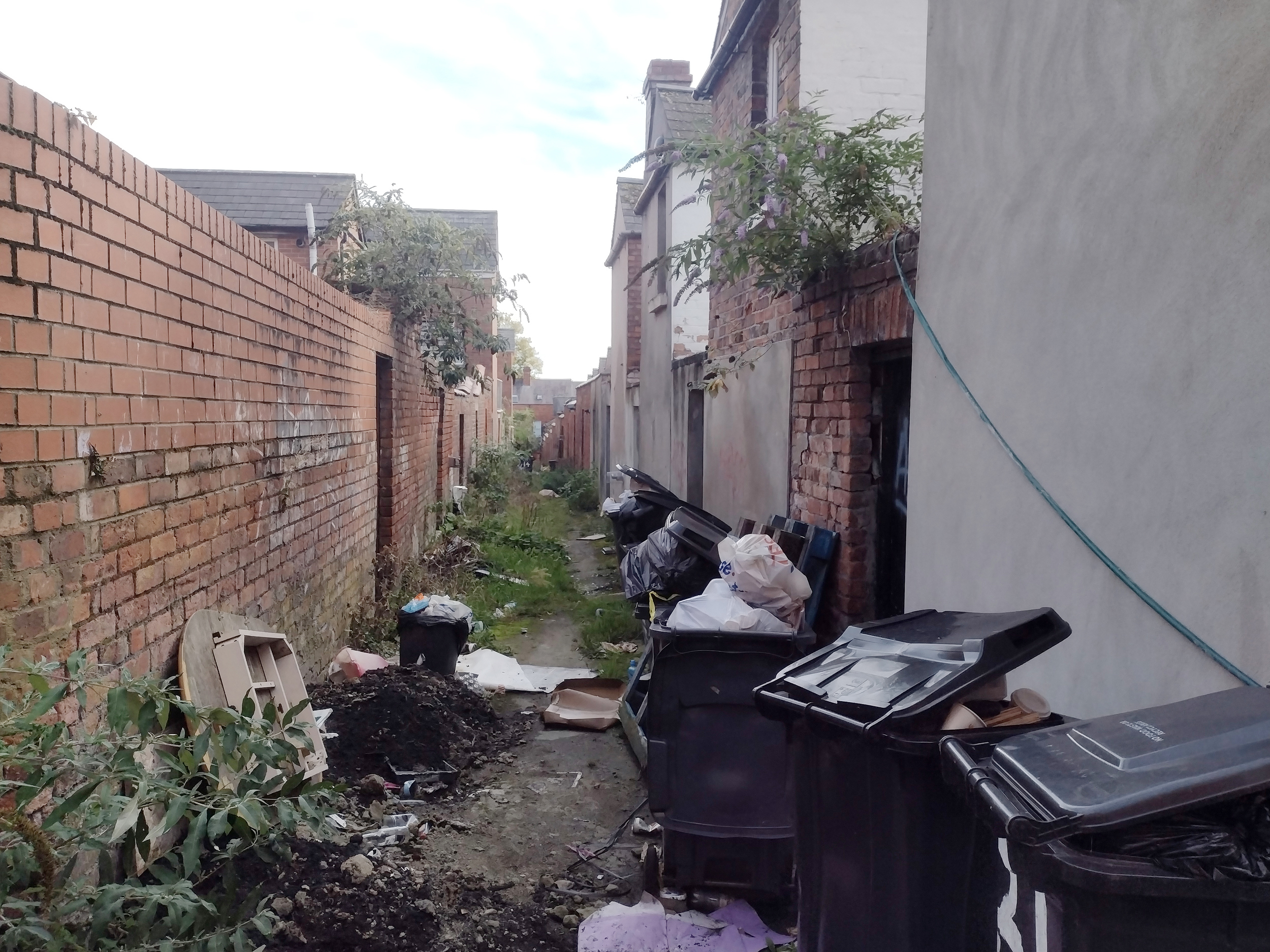
 Walk behind almost any terraced street in Belfast and you will find one: a narrow, unglamorous strip of tarmac, hemmed in by brick walls, usually associated with wheelie bins, weeds and the occasional flytipped mattress. Planners call it service infrastructure, and everyone else calls it ‘the alley’ and mostly ignores it (Alawadi et al., 2023). Yet these forgotten slivers of the city, easy to overlook, are quietly becoming one of the most interesting laboratories for community-led urban design anywhere in the UK. Belfast has a lot of these. City estimates put the alleyway network at around 202 kilometres (roughly the driving distance from Belfast to Dublin and back) woven invisibly through the city’s residential fabric. Most of that network is unremarkable, and much of it is genuinely neglected. But scattered across it is a growing constellation of small, resident-led transformations: a bin-strewn passage turned into a wildflower meadow, a dead-end lane repainted in rainbow colours, a dumping ground reborn as a shared garden. In 2026, Belfast City Council secured $1 million from the Bloomberg Philanthropies Mayors Challenge, one of only 24 cities worldwide selected from over 630 applicants, specifically to scale up this kind of resident-driven alley regeneration. A back lane, it turns out, can be a serious piece of urban policy.
Current state of most Belfast back alleys
The hidden logic of leftover space
Why does this matter beyond Belfast? Because alleyways are a perfect case study in something urban theory has struggled to take seriously: the productive power of ‘interstitial spaces’ (Gandy, 2022). Cities are usually imagined as built form, streets, squares and buildings, with everything else read as residual: gaps waiting to be filled or fixed. But interstitial spaces (the gaps, seams and leftovers of the urban fabric) are never empty or inert; they are ‘latent’ – or as Phelps and Silva (2018) argue – they are just ‘pending’ (Phelps and Silva, 2018). An alley that looks abandoned is not a void; it is a space suspended between what it currently is and what it could become, waiting for someone to notice it. There is a philosophical provocation hiding here. Architect Rem Koolhaas once wrote that ‘where there is nothing, everything is possible; where there is architecture, nothing else is possible’ (1995: 199), and the back alleys are precisely those nothing-places: too small, too marginal and too informally governed for architects and planners to have fully colonised them with intention. That is exactly what makes them so available to residents. Nobody needs planning permission to sweep a passage, plant a hanging basket, or paint a fence. The very neglect that makes alleys unloved is what leaves the door open for ordinary people to remake them.
Spatial alchemy (…one wheelbarrow at a time)
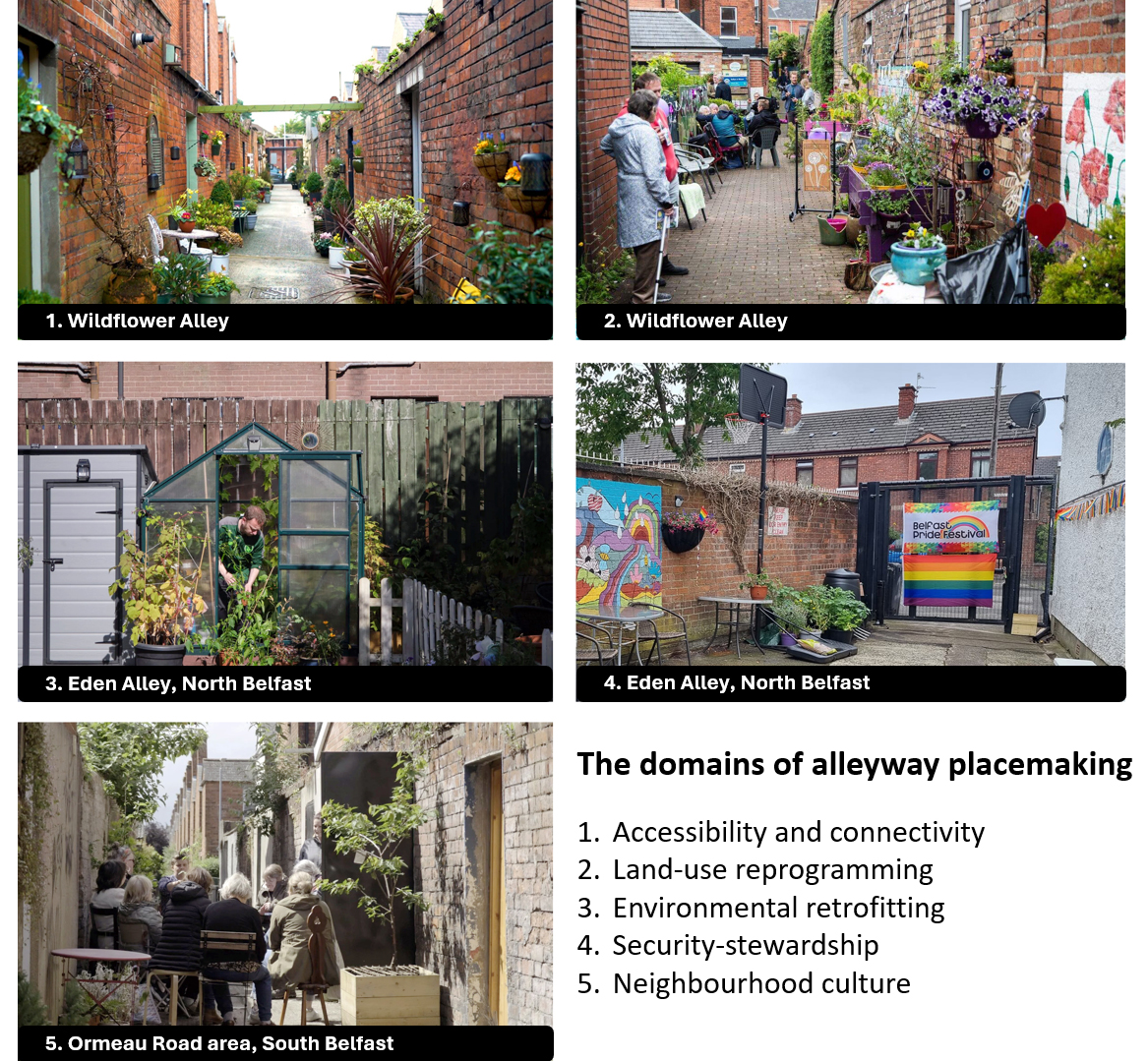
The transformation of dead space into living place through nothing more dramatic than sustained, everyday care is real spatial alchemy. My research tracked five community-led alleyway projects across Belfast (Eden Alley, Rainbow Alley, Wildflower Alley, Rossmore Alley and Miracle Way), spanning the north, south, east and west of the city, and found the same pattern recurring under different names; residents were not waiting for a masterplan. They were cleaning, planting, painting, gating and gathering, and in doing so, converting service corridors into something closer to shared gardens, safer walking routes, and informal community rooms. Five distinct kinds of work kept showing up: making the alley easier and safer to walk through; repurposing it for gardens, play or small-scale exchanges; greening it to manage rainwater and cool the local microclimate; securing it against anti-social behaviour, often through gating and better lighting; and, perhaps most importantly, weaving it into neighbourhood culture through murals, seed swaps, street dinners and the simple accumulation of neighbourly familiarity. Crucially, these are rarely separate interventions. A single wildflower planter can improve drainage, deter dumping, invite children to play and give neighbours a reason to talk over the fence, all at once!
Current state of regenerated back alleys
This matters particularly in a city like Belfast (still somehow governed by the long institutional aftershocks of ‘the Troubles’, 1968 to 1998), where shared space has historically been contested, divided and heavily managed. That an alley, of all places, can become a site of everyday reconciliation (where after years everybody knows each other’s names now) says something important about the scale at which peacebuilding and belonging actually happen: not always in grand civic gestures, but in the accumulation of small, repeated, physical acts of care.
A provocation for planners?
Here is the uncomfortable question this raises for urban design and planning practice: if some of the most resilient, low-cost and socially generative urban transformation is already happening in the spaces we have spent decades treating as technical afterthoughts, what exactly are our masterplans for? Alleyways cost little, require no demolition, and generate disproportionate returns in wellbeing, safety and social cohesion. Yet planning systems as we know (typically calibrated for streets, vehicles and formally zoned land uses) routinely fail to recognise, fund or protect this kind of bottom-up work until a Bloomberg-sized cheque forces the issue. Similar transformations are indeed emerging elsewhere. In Dublin, residents have converted rear laneways into shared gardens and play spaces. In Manchester, community groups have reclaimed service alleys as pedestrian routes and murals, while in Rotterdam overlooked passages now host micro enterprises and planting schemes. Across these cases, neglected interstices become sites of collective life through modest, resident led interventions.
The lesson for urban regeneration elsewhere is not that every city needs an alleyway strategy specifically. It is that interstitial spaces – whatever form they take locally (back lanes, cul-de-sacs, underpasses, leftover verges, or any other in-between ambiguous spatial domain) – are not exceptions to be tidied up before ‘real’ planning begins. They are where some of the most authentic, resident-owned placemaking is already under way, if planners are willing to look behind the street. In fact, Belfast’s alleyways have always been here since Victorian times: what has changed is not the alley, but the eye that meets it. The space was always latent; it required a shift in perception (before it could require a shift in matter) to become visible as a place at all. This is perhaps the quieter lesson of Belfast’s back lanes: cities do not wait for masterplans so much as for someone willing to see them differently.
References:
Alawadi, K., Alameri, H., & Scoppa, M. (2023). Reclaiming alleyways to improve network connectivity: Lessons from Dubai's neighborhoods. Journal of Planning Education & Research, 43(4), 917–939. Gandy, M. (2022). Ghosts and monsters: Reconstructing nature on the site of the Berlin Wall. Transactions of the Institute of British Geographers, 47(4), 1120–1136. Koolhaas, R. (1995). Imagining the nothingness. In S, M, L, XL. The Monacelli Press. Phelps, N. A., & Silva, C. (2018). Mind the gaps! A research agenda for urban interstices. Urban Studies, 55(6), 1203–1222. Silva, C. (2024). Interstitial constellations and their evocative emptiness. Lo Squaderno: Explorations in Space and Society, 67, 39–43. Silva, C. (2026). Interstitial placemaking: Unpacking the domains of relational urbanism of Belfast's alleyways. Journal of Urban Design.
Note:
This piece draws on my article ‘Interstitial placemaking: unpacking the domains of relational urbanism of Belfast’s alleyways’, published open access in the Journal of Urban Design (2026), and on an earlier essay on the aesthetics of urban emptiness published in Lo Squaderno (‘Interstitial constellations and their evocative emptiness’).




This Conversation is a compelling and thought-provoking contribution that invites us to reconsider what counts as meaningful public space and where urban transformation can begin.
The Conversation shows particularly well that Belfast’s back alleys are not merely residual or neglected spaces, but latent resources capable of supporting social interaction, environmental improvement and a renewed sense of belonging. I especially appreciate the idea of “spatial alchemy”: the transformation of ordinary service spaces through small, sustained acts of care rather than large-scale physical interventions.
Cleaning, planting, painting and gathering may appear modest, yet their combination can produce multiple benefits at once—improving safety and walkability, supporting biodiversity and climate adaptation, and strengthening relationships among neighbours. In Belfast, where public space continues to carry the legacy of division, this everyday construction of familiarity and trust acquires an even deeper significance.
The Conversation also offers an important message for planners. Recognising community-led action does not make planning irrelevant; rather, it suggests a different role for planning—one that enables, supports and protects local initiatives without absorbing their informality or weakening residents’ sense of ownership. The challenge is therefore to provide resources and continuity while preserving the openness that allows these transformations to emerge.
Belfast’s experience encourages us to look differently at the overlooked spaces present in every city. It also raises a valuable question: how can planning institutions support the transformation of interstitial spaces without formalising away the spontaneity, care and community agency that make them successful?
Thank you Marichela for the insightful reading. I particularly appreciate your question on how planning can support these transformations without formalising away the care, spontaneity and community agency that make them possible. This is perhaps where the research needs to go next, i.e., beyond Belfast and to examine how different planning cultures recognise and enable the latent potential of interstitial spaces.
A comparative exploration of back alleys, residual spaces and other urban ‘in-betweens’ across EU cities could help revealing whether Belfast’s alleyway transformation is a particular response to its social and spatial history or part of a broader form of community-led (DYI) urbanism. A study like this may also ask what forms of planning support, governance and resourcing can sustain these transformations while leaving sufficient openness for residents to shape them. The challenge, ultimately, is not simply to bring interstitial spaces into planning, but to learn how to plan with their incompleteness and relational potential. Yes, your final question provides a particularly strong bridge for a forward-looking agenda.