

12th PhD Winter School on Research Methodology
18/12/2025
Conversation #79
The Science of Invisibility in the Cities of the Global South, 2050
by Diosmar Filho
Iyaleta Research Association, Brazil
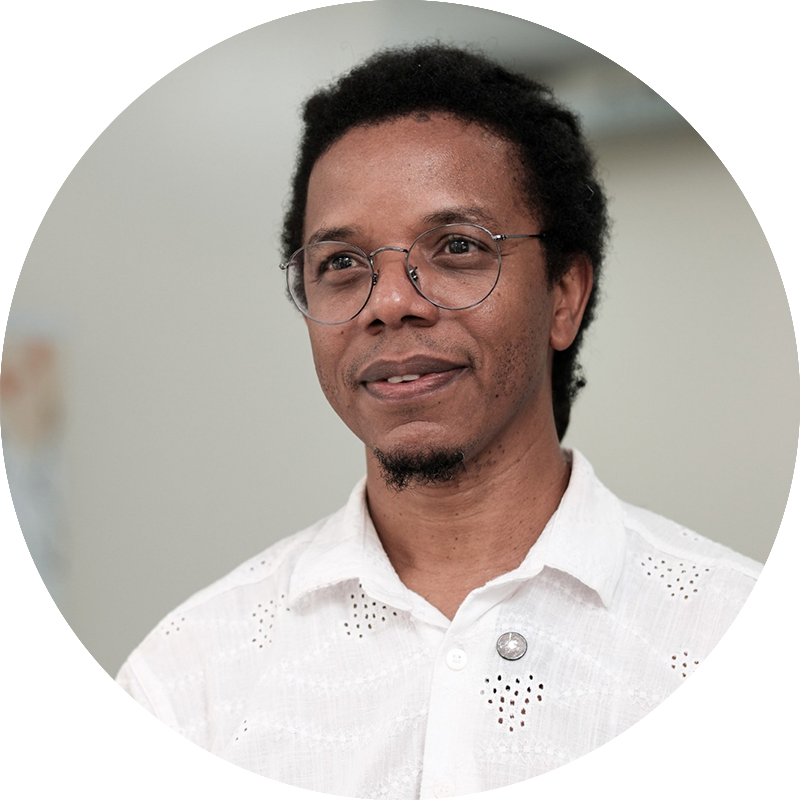 In this dialogue, I present ideas about the self, the collective, and the realities that escape us when we fail to speak of scientific ethics in the World-space. I do so as I declare my passion for the Spring, the season of colours and possibilities of the lands, territories, and bodies within the geographicity of history in motion towards a decarbonisation of and by humankind amid and against the perverse, intensifying globalisation of carbonisation.
Through colours, this year I walked for the first time in the city of Addis Ababa (Ethiopia) during Climate Week (CW2) of the United Nations Framework Convention on Climate Change (UNFCCC). Daisies enveloped the streets, houses, and local establishments in their vibrant, yellow colour, as Addis prepared for 11 September, Enkutatash (the New Year), a celebration to welcome the year 2018 (in the Ethiopian calendar) and take leave of the rainy season. As I traversed Addis, the open-air markets were full, in collective celebration of the season of food illuminated by jewels of humanity from the city’s day laborers, professionals, vendors, and families whose day to day lives – put into full evidence by the New Year celebration – remind us of what is truly at stake in the climate emergency we are living.
Addis' approach made it possible to reflect on the ethics of the “Science of Invisibility”, a concept that emerged in urban studies 44 years ago in Professor Milton Santos’ book Manual da Geografia Urbana (Manual of Urban Geography). Professor Santos directed scientific attention towards demographic data demonstrating that the world's urban population had risen from 1.7% at the end of the 19th century to 21% in the 1950s and then to 25% in the 1960s. In short, in 150 years, global urban life had multiplied (Santos, 2012). This trend data has been updated in the UN-HABITAT report Envisaging the Future of Cities (2022). More importantly, his work highlighted the perverse globalisation that has – by “selling” the “fable” of a benevolent globalization via mass media and other cultural channels – in real time, exponentially led to the expansion of the global urban population and by design has invisibilized how the realities, histories, and struggles of marginalized communities (Santos, 2006).
Undergirded by the idea that urbanization is built on invisibilized inequities, Envisaging the Future of Cities (2022) introduces the “Degree of Urbanisation” methodology to advance international urban comparison studies and enhance our capacity to read urban futures. They authors draw attention to the fact that, over the next 50 years cities will house 58% of the global population within “settlements in the urban-rural continuum (cities and semi-dense areas, as well as rural areas) are expected to decrease, with cities and semi-dense areas falling to 24% (from 29% in 2020) and rural areas to 18% (from 22%)” (UN-HABITAT, 2022). This trend overlays (and relies) on the intensifying social and economic inequality in cities (Fainstein, 2001; Glaeser et al., 2009), especially in the Global South (Shatkin, 2007). It is no secret that climate change intensifies urbanization by threatening the viability of traditional livelihoods (e.g. farming and fishing) in rural areas. Ironically, cities which contribute to emissions heighten this trend. This begs the question, “What can be done?”
This is inextricably linked to the urban demographic landscape and the imperative of reducing the planet's average temperature by 1.5°C before 2030. Climate change gives impetus for deep reflection and an opportunity to unmask the many “fables” undergirding rapid urbanization in the Global South. This impulse led us to the concept of “Science of Invisibility”, which can serve as the pathway towards the elimination of urban inequalities. This scientific approach is a conceptual reinterpretation of Professor Santos “banal space”1 that is anchored in the local, the regional and the territories that repudiate hegemonic, globalizing forces by embodying horizontal forms of occupying, dwelling, inhabiting and producing via this totalisation and totality of human bodies an avenue to and by Bem Viver (Good Living). The idea of “a good life,” has been heralded as a pathway for achieving sustainability through equity (e.g. see discussion on consumption corridors) and it manifests through the music, art, and colours of the Global South that reveal the potentialities of meaningful reactive and collective global climate action. The science of invisibility recognizes Ethiopian daisies as a form of climate adaptation and urban decarbonisation, in repudiation of scientific developments (e.g. industrial plants, data centers, etc.) that, between 1880 and 2024, have driven the planet´s average temperature from 0.1°C to 1.56°C (UNEP, 2024).
This dialogue that I am sharing here is an invitation – a provocation even – to contemplate and engage in the science of our century. Moving forward with developed local and sectoral adaptation plans that guarantee human rights, based on the elimination of gender and racial inequalities, with targets for eliminating urban vulnerabilities. (Santana Filho et al., 2022). We can no longer remain blind to the implications that global temperature data up to 2050 will have for the more than 58% of the global population who will be living in cities. Without a global commitment to reduce fossil fuels, the Earth's average temperature will reach 2.0°C. This challenges us to must embrace a new global scientific ethic grounded in the call to conscience offered by the principle of the Science of Invisibility.
Footnotes:
- Banal space refers to the everyday, all-encompassing space that is inhabited by everyone, without discrimination.
References:
Fainstein, S. S. (2001). Inequality in Global City-Regions. disP – The Planning Review, 37(144), 20–25. Glaeser, E. L., Resseger, M., & Tobio, K. (2009). Inequality in Cities. Journal of Regional Science, 49(4), 617–646. Porto-Gonçalves, C. W. (2002). From geography to geo-graphies: a world in search of new territoriality. In La Guerra Infinita: Hegemonía y terror mundial. CLACSO, 217–256. Santana Filho, D. M. de; Ferreira, A. J. F.; & Goes, E. F. (2022). Summary – Strategies for National Adaptation Plans: a case study from Brazil. Iyaleta – Research, Sciences, and Humanities. Santana Filho, D. M. de. (2025). A Letter to Belém: in the Urban Spring of the Global South, we will advance the Science of Invisibilities. Iyaleta – Research, Sciences and Humanities. Santos, M. (2006). For a New Globalisation: From Single Thought to Universal Consciousness. Rio de Janeiro: Record, 13th ed. Santos, M. (2011). Money and Territory. In Territory, territories: essays on territorial planning. Rio de Janeiro: Lamparina, 3rd ed., 13–21. Santos, M. (2012). Manual de Geografia Urbana. São Paulo: Edusp, 3rd ed., 232p. UN-HABITAT (2022). World Cities Report 2022 – Envisaging the Future of Cities. Nairobi: UN-Habitat. Shatkin, G. (2007). Global cities of the South: Emerging perspectives on growth and inequality. Cities, 24(1), 1–15. Tilley, L., Ranawana, A. M., Baldwin, A., & Tully, T. M. (2023). Race and climate change: Towards anti-racist ecologies. Politics, 43(2), 141–152.