EURA 2026 – Best Paper Award
EURA 2026 – Emerging Scholar Award
30/06/2026
EURA 2026 – Acknowledgment
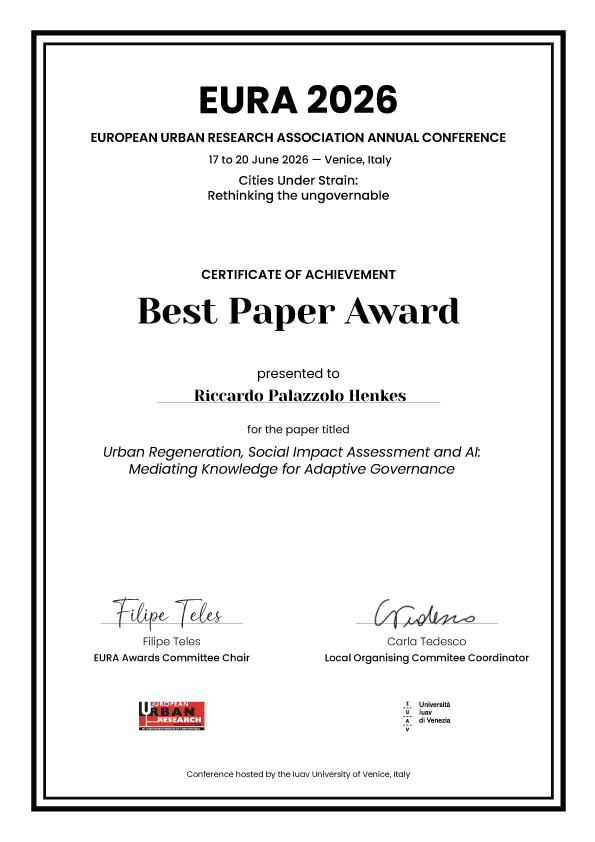
01/07/2026The papers titled "Learning to Reconfigure Housing Provision: Industrialised Construction and Collaborative Governance in Times of Crisis", by Emanuel Diogo and Alexandra Paio, and "Urban Regeneration, Social Impact Assessment and AI: Mediating Knowledge for Adaptive Governance", by Riccardo Palazzolo Henkes, won the EURA 2026 Best Conference Paper Award.
EURA 2026 Best Conference Paper Award
Winning Papers:
Learning to Reconfigure Housing Provision: Industrialised Construction and Collaborative Governance in Times of Crisis
Authors:Emanuel Diogo (Iscte – Instituto Universitário de Lisboa) and
Alexandra Paio (Iscte – Instituto Universitário de Lisboa; DINÂMIA’CET-Iscte)
Abstract
Across Europe, housing systems are increasingly destabilised by affordability crises, demographic ageing, climate change, and the financialisation of land and housing markets. These pressures are reshaping urban inequalities and exposing the limits of market-led provision models.
This paper examines the potential of alternative governance arrangements grounded in collaborative housing models and industrialised construction. Rather than treating modular or prefabricated systems as purely technical solutions, it foregrounds their political and institutional potential to reshape decision-making, enable participation, and support non-market forms of housing provision.
The paper draws on original research produced through a transdisciplinary pedagogical experiment conducted in 2025, involving over fifty participants from five European universities, a Portuguese municipality, and two local housing cooperatives. Through design-based research, participatory workshops, and collaborative prototyping, the project explored how modular typologies, prefabricated elements, and circular and bio-based materials could support collaborative and care-based modes of inhabitation.
The findings suggest that industrialised construction can become a governance enabler when aligned with public and community actors. Modular and prefabricated systems may reduce time and costs, support adaptive and democratic design processes, and facilitate shared spaces and community infrastructures. At the same time, the paper highlights the importance of enabling planning instruments, municipal capacity, access to land, and institutional innovation.
The paper concludes that industrialised methods, when combined with participatory governance and non-market actors, can contribute to more equitable, sustainable, and affordable housing systems.
Urban Regeneration, Social Impact Assessment and AI: Mediating Knowledge for Adaptive Governance
Author:Riccardo Palazzolo Henkes (Universidad Politécnica de Madrid, Spain)
Abstract
Urban regeneration processes increasingly unfold under conditions of uncertainty, institutional fragmentation, and contested decision-making. In this context, governance challenges concern not only the coordination of actors and policies, but also how different forms of knowledge are produced, mediated, and legitimised.
This paper argues that Social Impact Assessment (SIA) can be understood not merely as an evaluative or technical instrument, but as a key mechanism for mediating social knowledge and reshaping governance practices in urban regeneration.
Drawing on planning theory, governance studies, and social impact assessment literature, the paper conceptualises SIA as an infrastructure of knowledge mediation connecting expert analysis, institutional rationalities, and local, experience-based perspectives. It also examines the role of artificial intelligence as an enabling layer that can support the integration of heterogeneous data sources, predictive analysis, and the visualisation of social impacts over time.
Rather than treating AI as a neutral decision-making system, the paper critically frames it as a mediator that reshapes how social impacts are perceived, communicated, and acted upon within governance processes.
By reframing SIA and AI as mediators of knowledge rather than technical solutions, the paper contributes to debates on knowledge co-production, adaptive governance, and the role of emerging technologies in urban planning.
Congratulations once again to the winners, and thank you to all authors who participated in the conference and submitted papers!
The Best Conference Paper Award recognises outstanding contributions presented at the EURA Conference.
Find out more about the EURA Conference Awards!