

EURA 2026 – Early bird registration deadline
12/03/2026
Urban Research & Practice – Volume 19, Issue 1
15/04/2026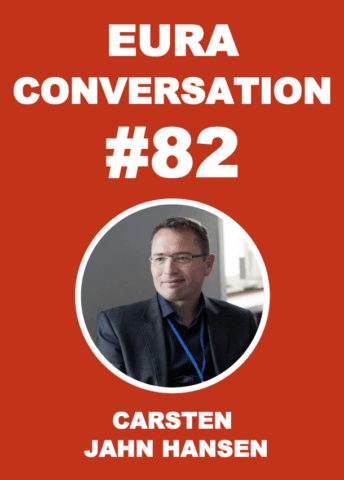
Conversation #82
Local soft spaces planning.
Bridging gaps between neighbourhoods, investors and authorities?
by Carsten Jahn Hansen
Aalborg University, Denmark
 For three decades I have had the privilege to research various kinds of innovations in spatial planning and its practices. I have primarily investigated placemaking, policymaking and planning activities concerning urban areas at local and regional levels in Denmark, but also in Sweden, Norway, the Netherlands, England, Northern Ireland, Scotland and France (Hansen et al., 2025a; Hansen et al., 2025b; Hansen et al., 2022; Olesen & Hansen, 2020). Repeatedly, I have encountered all sorts of urban development strategies and plans that were not born out of the formal (mandatory/statutory) spatial planning system – or from what has been labelled the ‘hard spaces’ of authority-based planning (Haughton and Allmendinger, 2007; Zimmerbauer & Paasi, 2020). Instead, such informal plans have emerged in a variety of situations, and involving an often (but not always) wider-spanning set of actors than the usual suspects of formal planning. Also, they often seem to involve a language that is still spatial but moves a good deal beyond land use regulation lingo, possessing a momentum that benefits from the wider local governance networks – thereby building legitimacy, co-production (See EC#77) and implementation power in ways that formal plans can sometimes only dream of.
Many planning scholars will recognise this as ‘soft spaces’ planning, a term often used to describe new spaces of non-mandatory development-oriented planning activities. It is frequently considered to be a supplement, and sometimes a challenge, to mandatory spatial planning activities. It can also encompass attempts to renew spatial planning through strategy, innovation, experimentation or increased attention to effectiveness. Until now, many soft space studies have focused on regional and metropolitan contexts, leading to discussions of, for instance, ‘fuzzy boundaries’, state-restructuring processes, adaptation to functional regions and more complex relational socio-economic geographies (Allmendinger & Haughton, 2009; Olesen & Hansen, 2020). Soft spaces are thought of as highly context-dependent, not only in relation to geography, focus and themes but also in relation to scales. Moreover, differences in planning systems and variations in democratic, governance and planning traditions and cultures seem to play a role in variations in soft spaces planning (Purkarthofer & Granqvist, 2021).
Hence, soft spaces planning can be seen as a much ‘messier’ kind of planning than ‘hard spaces planning’, and (perhaps because of that) some researchers and planners may fail to recognise it as spatial planning. However, at least we seem to witness a ‘travelling planning idea’ (Purkarthofer & Granqvist, 2021), and there are studies demonstrating how soft spaces planning carry range and power that formal plans don’t. On the other hand, soft spaces almost by definition lack the power vested in formal planning systems, e.g. regulatory powers. This is also why soft and hard spaces planning is often viewed as complementary rather than in opposition to each other (Cavaco et al., 2022).
Given that much work, including mine, has focussed on regional contexts, I have increasingly become interested in investigating soft spaces planning at local levels. Together with my AAU colleagues Henrik Halkier, Laura James, Frida Kunnerup and Tine Kyndi, and primarily funded by Realdania (a Danish philanthropic foundation), we established a research project that focuses exactly on that. We screened all 98 municipalities in Denmark, searching for soft space strategies and plans applying a holistic (cross-thematic) and comprehensive spatial perspective to urban neighbourhoods, city/town centres, suburbs, small towns and villages. In the Danish planning system these are formally the hard spaces domain of land use regulation-oriented municipal and local planning.
The first results were presented at the EURA 2025 conference (Hansen et al., 2025b). We identified 1,090 local soft space spatial plans, some of the most frequent labels and titles of the plans being: urban development plans, holistic plans, neighbourhood plans, strategic-physical development plans, masterplans, vision plans, local development plans, etc. We are currently finalizing 16 in-depth case studies, and can share some central observations from the Danish local context, where soft spaces spatial planning:
- can be found in all types of contexts and geographies: from large investor-driven urban development initiatives to socially oriented citizen-based neighbourhood and village development discussions;
- is often portrayed as ‘dialogue-plans’ that bridge the gap between neighbourhoods, investors and authorities;
- is often used to ‘soften’ the concept of planning and to create a more accessible local planning language;
- tries to fulfil demands from public, market and/or civic actors for local strategic approaches – how do ‘we’ fit into the greater picture and larger strategies?;
- is often essential for building governance spaces, partnerships, collaborations and co-productive relations for implementing planning, also formal planning;
- is often facilitated by municipalities, despite their extensive local formal spatial planning powers;
- is often used to create and legitimise the contents that end up in formal plans;
- is often used to supplement, complement but also develop existing hard space spatial plans;
- can be challenging for the planner who needs supplementary social and facilitation skills, while still being ‘the navigator’ and ‘gatekeeper’ in relation to existing comprehensive hard spaces planning;
- often challenges and creates a need for more organised local communities and neighbourhoods, a need for local civic place leadership and governance;
- requires strong political support, e.g. through the municipal council and its budgeting;
- pays special attention to challenges between and to designing workable combinations of hard and soft spaces planning.
While soft space planning may be fit-for-purpose planning spaces, interfaces between hard and soft planning spaces are continuously a challenge, and the widening use of soft plans is also increasing the need for coordination between soft plans themselves. Finally, soft space planning seems to push the boundaries of spatial planning itself to embed more legitimisation mechanisms and increase the power of more social approaches to planning.
So, why are we reaching out through the EURA conversation platform? We are very interested in learning more about local soft spaces planning experiences from various kinds of places and contexts outside Denmark. E.g. what is similar and what differs? Feel free to comment or to reach out.
References:
Allmendinger, P., & Haughton, G. (2009). Soft Spaces, Fuzzy Boundaries, and Metagovernance: The New Spatial Planning in the Thames Gateway. Environment and Planning A, 41(3), 617–633. Cavaco, C., Mourato, J., Costa, J. P., & Ferrão, J. (2022). Beyond soft planning: Towards a Soft turn in planning theory and practice? Planning Theory, 22(1), 3–26. Hansen, C. J., Azzopardi, E., Béguier, I., Ferguson, L., Flannery, W., & Frangoudes, K. (2022). Building planning spaces for the integration of coastal and maritime cultural heritage in local and regional spatial development. Maritime Studies, 21(4), 425–435. Hansen, C. J., Kristensen, N. G., Elle, M., & Bodum, L. (2025a). Building place-sensitive perspectives between strategy and participation: a planning doctrine in the making. In M. Freudendal-Pedersen, J. Luel-Stissing, & D. Galland (eds.), Planning for Urban Sustainability. Edward Elgar Publishing. Hansen, C. J., Halkier, H., & James, L. (2025b). Appropriate local planning spaces for place-sensitive urban development – the increased use of non-statutory neighbourhood planning in Denmark. Abstract from European Urban Research Association Conference 2025, Bristol, UK, 10–13 June. Haughton, G., & Allmendinger, P. (2007). ‘Soft Spaces’ in Planning. Town & Country Planning, 76, 306–308. Olesen, K., & Hansen, C. J. (2020). Introducing Business Regions in Denmark: The ‘Businessification’ of Strategic Spatial Planning? Environment and Planning C: Politics and Space, 38(2), 366–383. Purkarthofer, E., & Granqvist, K. (2021). Soft Spaces as a Traveling Planning Idea: Uncovering the Origin and Development of an Academic Concept on the Rise. Journal of Planning Literature, 36(3), 312–327. Zimmerbauer, K., & Paasi, A. (2020). Hard Work with Soft Spaces (and Vice Versa): Problematizing the Transforming Planning Spaces. European Planning Studies, 28(4), 771–789.





Above, Carsten Jahn Hansen provides an excellent glimpse into the debate of soft spaces in academic circles, and it will not be challenging for those doing/researching planning practice to identify similar cases in their own work. As I have argued earlier (e.g. Purkarthofer, 2018), even at EU level, there is agreement that new geographical delineations and new governance arrangements are needed to address pressing challenges. In a European Commission report entitled “Cities of tomorrow” it is emphasized that “administrative boundaries of cities no longer reflect the physical, social, economic, cultural or environmental reality of urban development and new forms of flexible governance are needed” (European Commission, 2011, p. VI). The EU itself, cross-border regions, city-regions as well as neighborhoods are mentioned as examples of such new flexible action spaces. There are also some EU funding instruments available for such soft spaces, also at the local level, for example as part of Community-Led Local Development (CLLD). It would be interesting to hear whether such funding instruments played any role in the creation of the soft spaces and soft planning approaches identified in Denmark above. Typically, Denmark tends to be Eurosceptic, but sometimes such attitudes are sidelined when new opportunities to receive funding appear.
There is one more observation I would like to add here – and I would be happy to hear different viewpoints on this. Above, Carsten writes that soft planning / planning in soft spaces (we can discuss elsewhere whether these are the same thing) can be seen as “the much messier kind of planning”. However, what seems to become increasingly clear to me the longer I do planning research is that “hard planning” is messy from start to finish. Bent Flyvbjerg’s Aalborg case study (Flyvbjerg, 1998) is a compellingly written illustration of that messiness, and many others have made similar observations. In a sense, it seems that soft planning more clearly acknowledges the messy elements – if not in practice at least in research. Without glossing over the need to critically discuss issues such as legitimacy (see e.g. Bäcklund et al., 2018), there is some satisfying honesty in the attitude of “we are making this up as we go” sometimes found in soft planning.
Thanks Eva. Excellent comment.
Yes, some EU initiatives have influenced this kind of planning in skeptical Denmark too, e.g. through ‘local action groups’ activities. Also, there is a ‘phenomenon within the phenomenon’ called ‘local development plans’ used in many rurally dominated municipalities, and where some work has been done to try to establish both general guidelines and particular planning models for this in Danish municipalities. In relation to that, it seems that there has been at least a mindset influence from EU agendas and programmes.
And the point about hard spaces (also) being ‘messy from start to finish’ is something I can very much relate to and see occuring in our cases . There is always messiness in planning, and it might well be the case that local soft spaces are more honest and open about it, while hard spaces may try to suppress messiness, and then as a result, unintentionally perhaps, help to create more messiness in the end.